
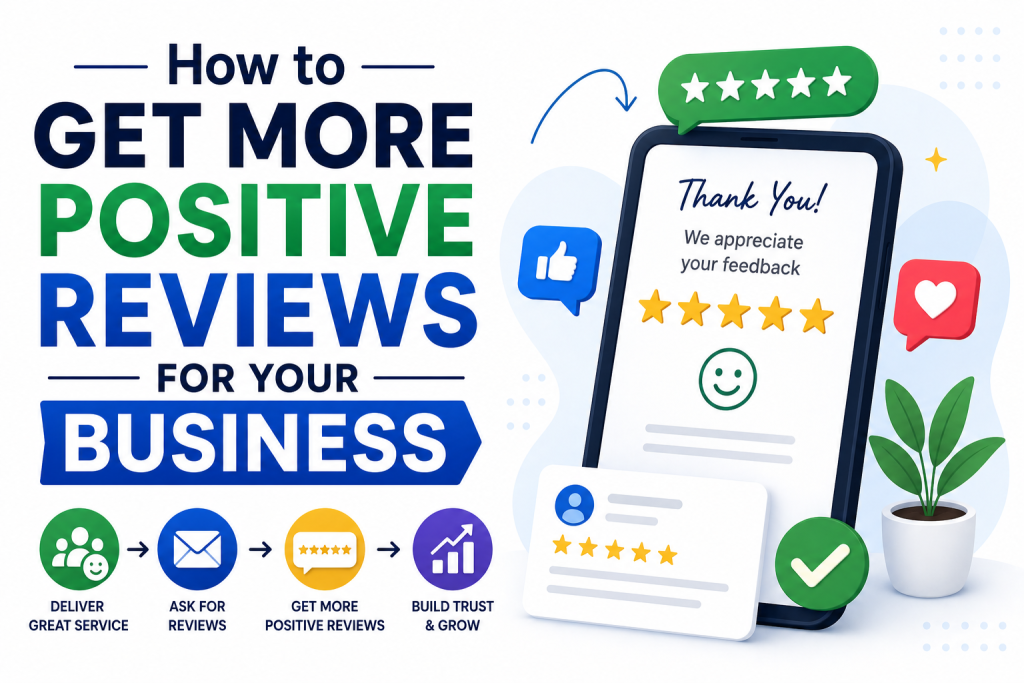
Why Positive Reviews Are Essential for Business Growth
Positive online reviews have become one of the strongest drivers of customer trust and business growth. Before purchasing a product, booking a service, visiting a restaurant, or hiring a company, most consumers research reviews to understand the experiences of previous customers.
For businesses, positive reviews offer benefits that extend far beyond reputation management. They influence search engine visibility, conversion rates, customer loyalty, and brand perception. A strong review profile can help businesses attract new customers while strengthening relationships with existing ones.
However, getting more positive reviews is not about manipulating customers or using shortcuts. Sustainable review growth comes from delivering exceptional experiences and creating systems that encourage satisfied customers to share their feedback naturally.
Understanding how to generate more positive reviews ethically and effectively is essential for businesses operating in today’s digital marketplace.
Why Customers Read Reviews Before Buying
Modern consumers rely heavily on social proof.
Before making decisions, customers often want answers to questions such as:
- Can this business be trusted?
- Do other customers recommend it?
- Is the service consistent?
- Are there hidden problems?
- Does the company deliver what it promises?
Positive reviews help answer these questions and reduce uncertainty.
Studies consistently show that customers are more likely to purchase from businesses that demonstrate:
- Strong ratings
- Recent reviews
- Authentic customer experiences
- Professional responses
- Consistent service quality
Because reviews influence purchasing behavior, businesses that invest in customer satisfaction often gain significant competitive advantages.
Deliver an Outstanding Customer Experience First
The foundation of every positive review strategy is customer experience.
Businesses sometimes focus heavily on collecting reviews while overlooking the actual experience customers receive.
Positive reviews typically result from:
- Excellent service
- Quality products
- Fast communication
- Professional support
- Reliable delivery
- Personalized experiences
If customer expectations are not being met, requesting reviews aggressively will rarely produce sustainable results.
Before focusing on review growth, businesses should ask:
- Are customers satisfied?
- Are complaints resolved quickly?
- Is service delivery consistent?
- Do customers recommend us naturally?
The best review strategy begins with operational excellence.
Ask Customers Directly
One of the simplest and most effective ways to increase positive reviews is to ask customers.
Many satisfied customers never leave reviews because they simply forget or assume their feedback is unnecessary.
Businesses can request reviews through:
Email Follow-Ups
Post-purchase emails remain one of the most effective review collection methods.
Examples include:
- Product delivery confirmations
- Service completion emails
- Customer satisfaction surveys
- Thank-you messages
Customers are often willing to leave reviews when asked politely.
SMS Messages
Text messaging frequently produces high response rates.
SMS requests work well because they are:
- Immediate
- Convenient
- Mobile-friendly
- Easy to complete
Businesses should keep messages concise and professional.
In-Person Requests
For local businesses, personal requests can be extremely effective.
Employees can ask satisfied customers to share their experiences online.
This approach often produces highly authentic reviews.
Ask at the Right Time
Timing plays a critical role in review generation.
The best time to request feedback is often when customer satisfaction is highest.
Examples include:
Immediately After Successful Service
Customers are most likely to leave reviews when they feel satisfied and appreciated.
After Product Delivery
Positive experiences shortly after receiving products often generate strong reviews.
Following Problem Resolution
Customers whose issues were resolved effectively may become enthusiastic reviewers.
During Follow-Up Communication
Customer check-ins create natural opportunities to request feedback.
The closer the request is to the positive experience, the higher the response rate tends to be.
Make Leaving Reviews Easy
Customers appreciate convenience.
Complicated review processes significantly reduce participation.
Businesses can improve completion rates by providing:
- Direct review links
- QR codes
- Mobile-friendly pages
- Simple instructions
- One-click access
Reducing barriers makes customers more likely to complete the review process.
Even satisfied customers may abandon complicated workflows.
Build a Consistent Review Collection Process
Many businesses request reviews inconsistently.
Successful organizations develop repeatable systems.
Examples include:
- Automated email sequences
- CRM integrations
- Customer support workflows
- Service completion triggers
- Marketing automation tools
Consistency creates predictable review growth.
Rather than requesting reviews occasionally, businesses should incorporate review generation into everyday operations.
Focus on Customer Relationships
Customers who feel valued are more likely to leave positive feedback.
Relationship-building strategies include:
- Personalized communication
- Prompt responses
- Follow-up support
- Loyalty programs
- Customer appreciation efforts
Strong relationships increase both customer retention and review participation.
People often review businesses they trust and appreciate.
Train Employees to Support Review Growth
Employees directly influence customer experiences.
Businesses should train staff to understand:
- The importance of reviews
- Appropriate review requests
- Customer satisfaction principles
- Platform policies
- Professional communication
Employees should never pressure customers.
Instead, they should create positive experiences that naturally encourage feedback.
Well-trained teams often generate stronger reputations.
Respond to Existing Reviews
Businesses that respond to reviews demonstrate that they value customer feedback.
Responses can encourage future customers to leave reviews because they show:
- Engagement
- Accountability
- Appreciation
- Professionalism
Businesses should respond to:
Positive Reviews
Express gratitude and reinforce positive experiences.
Negative Reviews
Address concerns respectfully and professionally.
Neutral Reviews
Provide clarification and demonstrate customer commitment.
Review responses contribute to overall reputation quality.
Encourage Honest Feedback
Some businesses make the mistake of asking only for positive reviews.
This approach can create several problems.
Consumers generally trust businesses that have:
- Mostly positive reviews
- Some constructive criticism
- Authentic customer experiences
- Balanced feedback profiles
Perfect ratings may appear artificial.
Encouraging honest reviews creates greater credibility.
Authenticity is often more valuable than perfection.
Use Review Reminder Campaigns
Customers frequently intend to leave reviews but forget.
Gentle reminder campaigns can improve participation.
Examples include:
- Follow-up emails
- SMS reminders
- Customer account notifications
- Post-service communications
Businesses should avoid excessive reminders, which may create frustration.
Effective reminders are:
- Polite
- Brief
- Professional
- Convenient
Diversify Review Platforms
Relying exclusively on one platform creates unnecessary risk.
Businesses should consider building reviews across multiple channels.
Examples include:
Google Reviews
Essential for local search visibility and customer trust.
Facebook Reviews
Useful for social proof and community engagement.
Trustpilot
Popular for e-commerce and professional services.
Industry-Specific Platforms
Examples include:
- Healthgrades
- TripAdvisor
- G2
- Capterra
- Avvo
Diversification strengthens overall reputation resilience.
Avoid Review Incentives
Offering rewards in exchange for reviews may violate platform policies.
Examples include:
- Cash payments
- Discounts
- Gift cards
- Free products
- Contest entries
Although incentives may increase review volume temporarily, they create significant risks.
Businesses should focus on authentic customer motivation instead.
Genuine experiences produce stronger and more trustworthy reviews.
Monitor Customer Satisfaction
Review growth depends heavily on customer satisfaction.
Businesses should regularly monitor:
- Customer feedback
- Support interactions
- Complaint trends
- Service quality
- Product performance
Early problem detection improves customer experiences and reduces negative reviews.
Monitoring helps businesses identify opportunities for improvement.
Address Negative Experiences Quickly
Every business receives complaints.
The difference between strong and weak reputations often lies in how organizations respond.
Businesses should:
- Acknowledge problems quickly
- Take responsibility when appropriate
- Offer solutions
- Follow up with customers
- Learn from feedback
Customers who experience effective problem resolution sometimes become the strongest advocates.
Build Long-Term Trust
Positive review growth is a long-term process.
Businesses that prioritize trust often experience:
- Higher retention
- Better referrals
- Greater customer loyalty
- Stronger reputations
- Sustainable growth
Trust develops through:
- Consistency
- Transparency
- Reliability
- Customer care
Quick fixes rarely produce lasting results.
Common Mistakes Businesses Make
Several common mistakes can undermine review growth efforts.
Waiting Too Long to Ask
Delayed requests often reduce response rates.
Ignoring Customer Complaints
Unresolved issues create negative experiences.
Violating Platform Policies
Policy violations may result in penalties.
Focusing Only on Quantity
Review quality matters more than volume alone.
Pursuing Perfect Ratings
Consumers often trust realistic ratings more than flawless scores.
Avoiding these mistakes improves long-term outcomes.
The Future of Customer Reviews
Review systems continue evolving rapidly.
Emerging trends include:
- Artificial intelligence moderation
- Review authenticity verification
- Identity validation
- Behavioral fraud detection
- Reputation analytics
- Automated review management
As technology advances, authentic customer feedback will become even more valuable.
Businesses that prioritize genuine experiences today will be better positioned for future success.
Conclusion
Getting more positive reviews requires more than asking customers to leave feedback. Successful businesses create exceptional experiences, build strong relationships, simplify the review process, and consistently encourage authentic customer participation.
While shortcuts and manipulation tactics may appear attractive, they often create unnecessary risks and undermine long-term trust. Businesses that focus on customer satisfaction, transparency, and ethical review practices can build strong reputations that support sustainable growth.
Positive reviews are not merely marketing assets. They are reflections of customer experiences and one of the most powerful forms of trust available in the digital economy.
FAQ
What is the best way to get more positive reviews?
The most effective strategy is delivering excellent customer experiences and asking satisfied customers to share honest feedback.
When should businesses ask for reviews?
Businesses should request reviews shortly after positive customer experiences or successful transactions.
Can businesses pay customers for reviews?
Most review platforms prohibit paid or incentivized reviews.
How important are online reviews?
Online reviews significantly influence customer trust, purchasing decisions, and business reputation.
Should businesses respond to reviews?
Yes. Professional responses improve trust and encourage customer engagement.
Which review platform matters most?
Google Reviews is often the most important platform, although industry-specific sites also play a major role.
Is it okay to ask customers for positive reviews?
Businesses should request honest feedback rather than specifically asking for positive reviews.
How many reviews does a business need?
The ideal number varies by industry, but consistent review growth is generally more important than achieving a specific total.
Do negative reviews hurt businesses?
A few negative reviews can actually improve credibility if businesses respond professionally.
Can businesses remove negative reviews?
Most negative reviews remain unless they violate platform policies.