
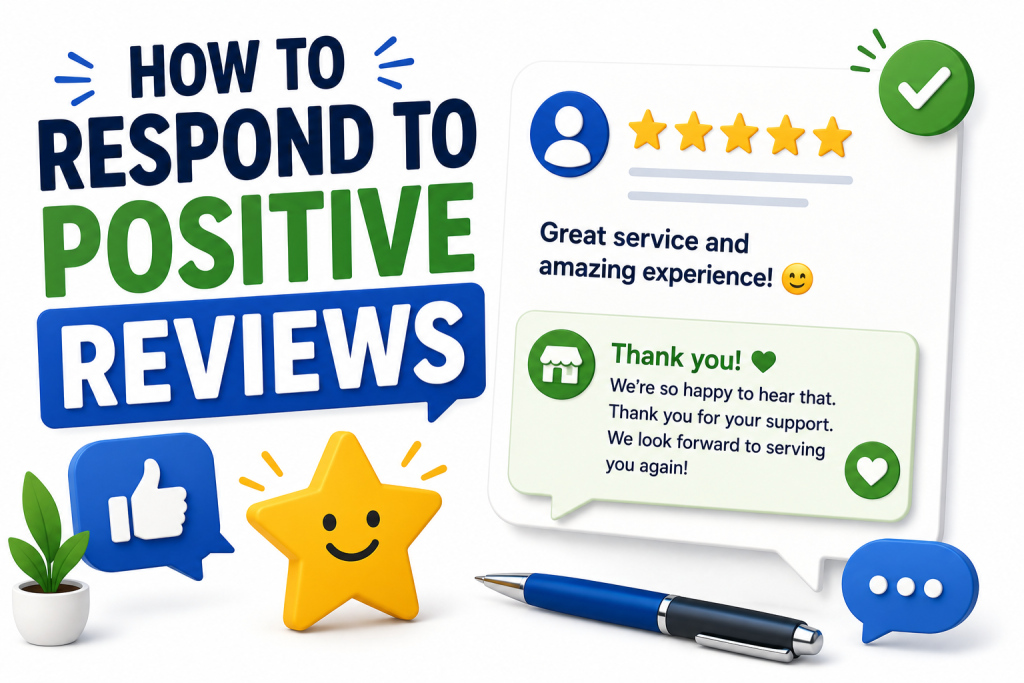
Positive customer reviews are valuable for any business. They show that customers are willing to share their experiences and can give potential buyers additional confidence when they are considering a company.
However, receiving a positive review should not be the end of the conversation.
A thoughtful response can show appreciation, strengthen the customer relationship, and demonstrate to future customers that the business pays attention to feedback.
The best responses do not need to be long or complicated. A genuine thank you, a reference to something specific in the review, and a friendly closing can often be enough.
Why Respond to Positive Reviews?
A customer has taken the time to write about their experience.
Responding shows that the business noticed and appreciated that effort.
Positive review responses can also help demonstrate the personality of a company.
Potential customers may read both reviews and business responses when evaluating a company. A business that responds thoughtfully can appear more attentive and customer focused.
Start With a Genuine Thank You
The simplest response is often the most important.
Thank the customer for taking the time to leave feedback.
For example:
“Thank you for sharing your experience with us. We really appreciate your kind feedback.”
This acknowledges the customer’s effort without making the response overly complicated.
Mention Something Specific
A response becomes more personal when it refers to something the customer actually mentioned.
If a customer praises your support team, acknowledge the team.
If they mention a product they enjoyed, refer to that product.
If they appreciate fast delivery, mention it.
For example:
“Thank you for your kind words about our support team. We are glad they were able to make your experience easier.”
This feels more genuine than a generic thank you.
Keep the Tone Natural
Your response should sound like it comes from a real business.
Avoid overly formal or promotional language.
You do not need to turn every review response into a sales message.
The purpose is to thank the customer and maintain the relationship.
A natural response can be warm, professional, and concise.
Personalize Your Response
If the customer’s name is publicly available and appropriate to use, you can address them personally.
For example:
“Thank you, Priya. We are glad you enjoyed your experience.”
Personalization can make a response feel more direct.
However, do not use personal information that the customer did not make public.
Acknowledge the Customer’s Experience
Try to show that you actually read the review.
If the customer describes a specific experience, acknowledge it.
For example:
“Thank you for mentioning how easy you found the booking process. We have worked hard to make scheduling as simple as possible.”
This communicates that the business values the customer’s specific feedback.
Recognize Your Employees
If a customer mentions a particular employee, acknowledge that contribution.
For example:
“We will be sure to share your kind words with our team. They will be happy to know their support made a difference.”
This can also help employees understand what customers appreciate about their work.
Avoid Turning Every Response Into an Advertisement
A positive review is not necessarily an opportunity for a sales pitch.
Avoid filling your response with promotional offers, product links, or unrelated announcements.
A simple thank you is often more effective.
The customer already had an experience with your business. Your response should focus on appreciating that experience.
Keep Responses Concise
You do not need to write a paragraph for every short review.
If the customer writes:
“Great service. Very helpful team.”
A suitable response might be:
“Thank you for the kind words. We are glad our team could help and really appreciate your feedback.”
Short reviews can receive short responses.
More detailed reviews can receive more detailed responses.
Respond to Detailed Reviews With Detail
When a customer spends time writing a thoughtful review, give them a thoughtful response.
If they mention several parts of their experience, acknowledge the most relevant ones.
This shows that their effort was noticed.
You do not need to respond to every sentence, but referring to one or two specific points can make the response feel more personal.
Use Positive Reviews to Reinforce Your Strengths
Reviews can show what customers appreciate about your business.
If customers repeatedly praise:
Fast service
Helpful staff
Product quality
Easy ordering
Professional communication
Reliable delivery
you can use those insights internally.
Your response can acknowledge these strengths naturally.
For example:
“We are delighted that you found the ordering process straightforward. Making the experience simple for customers is something our team continues to focus on.”
Do Not Overpromise
A positive review may tempt a business to make broad claims.
Avoid statements that promise things you cannot consistently deliver.
For example, instead of saying:
“We will always provide the fastest service in the industry.”
simply thank the customer for recognizing the service they received.
Authentic responses are more credible.
Do Not Copy the Same Response Everywhere
Using the same sentence for every review can make your responses look automated.
You can have a basic response structure, but adjust it according to the review.
For example:
Thank the customer.
Mention something specific.
Express appreciation.
Close naturally.
This creates consistency without making every response identical.
Respond Promptly
There is no need to respond within minutes, but avoid leaving positive reviews unanswered for long periods when possible.
Regularly monitoring your reviews makes it easier to acknowledge new feedback.
A consistent response process can also help ensure that reviews do not get overlooked.
Respond Across Important Platforms
Customers may leave reviews on different platforms.
Depending on your industry, this could include business listings, social platforms, industry directories, marketplaces, or dedicated review websites.
Prioritize the platforms that matter most to your customers.
You do not need to create complicated responses for every website.
The important thing is to acknowledge meaningful feedback consistently.
Use the Customer’s Language Naturally
If a customer writes in a friendly and casual style, a warm response can work well.
If the customer writes professionally, keep your response professional.
Match the general tone without trying too hard to imitate the customer.
The response should still sound like your business.
Do Not Ask for Another Review Immediately
A positive review is already valuable.
Avoid immediately responding with a request for another review or asking the customer to post the same feedback elsewhere.
Instead, focus on appreciation.
If your business has a separate process for inviting customers to share feedback on another appropriate platform, keep that request separate and make sure it follows the platform’s rules.
Use Positive Reviews as Learning Opportunities
Positive reviews can reveal what customers value.
For example, customers may repeatedly mention:
Friendly staff
Easy communication
Fast problem solving
Quality products
Convenient booking
Reliable delivery
These themes can help management identify what should be protected as the business grows.
Share Useful Feedback With Employees
When customers praise employees, share that feedback with the team.
Recognition can help employees understand how their work affects customers.
For example, if several customers praise a support representative for clear explanations, that behavior can become an example for the wider team.
Positive reviews can therefore support internal training and motivation.
Turn Positive Feedback Into Business Insights
Do not look at positive reviews only as reputation content.
Analyze them.
Ask:
What do customers praise most?
Which services receive the strongest feedback?
What words appear repeatedly?
What parts of the customer journey are mentioned?
Are certain employees frequently recognized?
These answers can reveal your strongest customer experience areas.
Use Reviews to Understand Customer Expectations
A positive review can also tell you what customers expect from your business.
Suppose customers repeatedly praise quick communication.
That suggests response speed is important to them.
If customers frequently mention clear pricing, transparency may be one of your competitive strengths.
These insights can help shape future customer service decisions.
Avoid Revealing Private Information
Even when a customer leaves a positive review, be careful about what you share in your response.
Do not reveal:
Private account information
Payment details
Personal contact information
Order details that should remain private
Private conversations
If a detail is not already public and is not necessary, leave it out.
What If the Review Has a Minor Complaint?
Sometimes a positive review includes constructive criticism.
For example:
“Great service and friendly staff, but the waiting time was longer than expected.”
Do not ignore the criticism simply because the overall review is positive.
Thank the customer and acknowledge the suggestion.
For example:
“Thank you for sharing your experience. We are glad you enjoyed the service and appreciate your feedback about the waiting time. We will review this with our team.”
This shows that the business listens to all parts of the feedback.
Positive Review Response Examples
Short and Professional
“Thank you for taking the time to share your feedback. We really appreciate your support and are glad you had a positive experience.”
Friendly
“Thank you for the kind words. We are so glad you enjoyed your experience and truly appreciate you choosing us.”
Service Focused
“Thank you for your wonderful feedback. We are happy to hear that our team could provide the experience you were looking for.”
Product Focused
“Thank you for sharing your experience with us. We are delighted to hear that you are enjoying the product and appreciate your support.”
Employee Recognition
“Thank you for your thoughtful review. We are especially glad to hear that our team was able to help. We will be sure to share your kind words with them.”
Detailed Review
“Thank you for taking the time to share such detailed feedback. We are glad to hear that the service, communication, and overall experience met your expectations. Your comments mean a lot to our team.”
Common Mistakes When Responding to Positive Reviews
Businesses can make simple mistakes even when responding to praise.
Avoid:
Using the exact same response every time
Writing overly promotional messages
Ignoring specific customer comments
Making unrealistic promises
Sharing private information
Asking for another review immediately
Using overly formal language
Writing extremely long responses to short reviews
A good response should feel natural and appropriate to the review.
Create a Simple Response Framework
A business can make positive review management easier with a basic framework.
Start by thanking the customer.
Next, mention something specific from their review.
Then express appreciation for their support.
Finally, close with a friendly statement.
For example:
“Thank you for sharing your experience. We are glad you found our service easy to use. We appreciate your support and hope to serve you again.”
This structure is flexible enough to adapt to different reviews.
Final Thoughts
Responding to positive reviews is a simple way to show customers that their feedback matters.
The best responses are genuine, personal, and relevant.
Thank customers for their time, mention something specific, recognize helpful feedback, and avoid turning every response into a sales message.
Positive reviews can also provide valuable information about what your business does well. Pay attention to recurring praise and use those insights to strengthen your customer experience.
A strong review profile is not created only by collecting feedback. It is also shaped by how a business communicates with the people who take the time to share it.
When customers see that their opinions are noticed and appreciated, they have another reason to feel connected to the business.
Frequently Asked Questions
Why should businesses respond to positive reviews?
Responding shows customers that the business appreciates their feedback and pays attention to their experiences. It can also help demonstrate a customer focused approach to potential customers.
What should I say when responding to a positive review?
Start with a genuine thank you, mention something specific from the review, and express appreciation for the customer’s support.
How long should a positive review response be?
Usually, a few sentences are enough. The response should match the length and detail of the customer’s review.
Should I respond to every positive review?
Responding to meaningful reviews is a good practice when practical. Businesses with a large volume of reviews may prioritize detailed or particularly useful feedback while maintaining a consistent approach.
Should I use the customer’s name?
If the name is publicly displayed and appropriate to use, personalizing the response can make it feel more genuine.
Should I promote my business in a positive review response?
Avoid turning every response into an advertisement. Focus primarily on thanking the customer and acknowledging their experience.
Can I ask a customer for another review after they leave a positive review?
It is generally better to focus on appreciation in the response. Any additional review request should be handled separately and according to the applicable platform rules.
Should I use the same response for every review?
It is better to personalize responses. You can use a basic structure while changing the wording and referencing specific details from each review.
What if a positive review contains a complaint?
Acknowledge both the positive feedback and the concern. Thank the customer for sharing the suggestion and explain that the business will consider or investigate the issue.
Can positive reviews help improve my business?
Yes. Positive reviews can reveal what customers value, such as helpful employees, product quality, fast service, or easy communication.
Should I share positive reviews with employees?
Yes. Customer praise can help employees understand what customers appreciate and can provide useful examples for internal recognition and training.
How quickly should I respond to positive reviews?
Try to respond consistently rather than leaving reviews unattended for long periods. The ideal timing depends on your review volume and available resources.
Should my response sound formal?
The tone should match your brand and the customer’s review. In most cases, a professional but natural response works well.
Can I mention specific services in my response?
Yes, when relevant to the customer’s review. Avoid forcing keywords or promotional language into the response.
What is the biggest mistake when responding to positive reviews?
Making every response sound automated. Customers appreciate responses that show the business actually read and valued their feedback.