
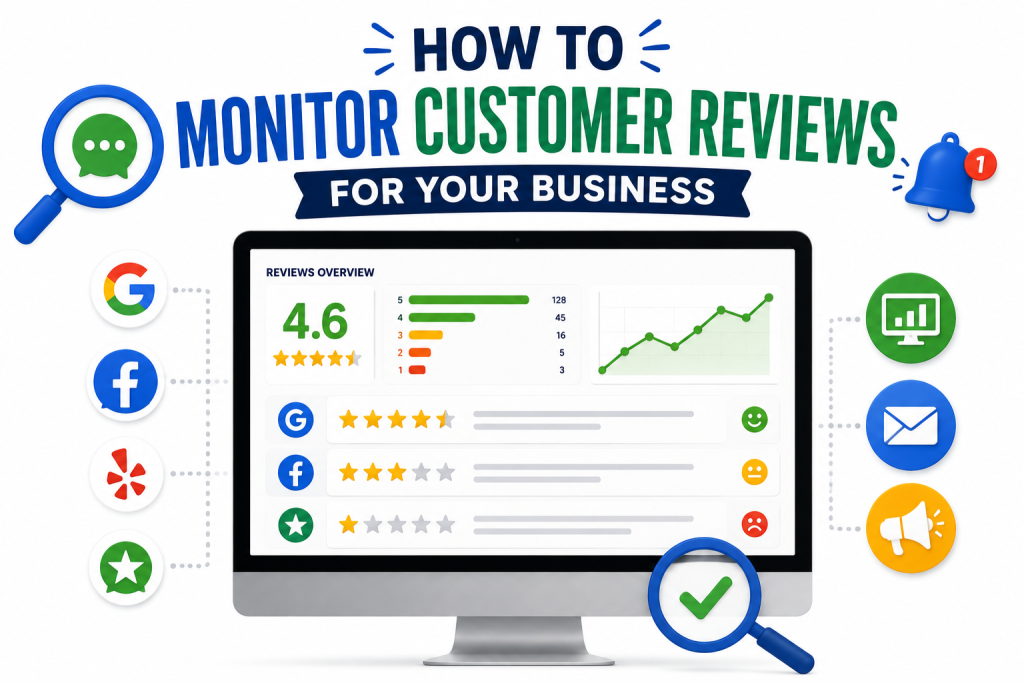
Customer reviews can tell you a lot about how people experience your business.
A review can highlight excellent service, reveal a problem with a product, point out communication issues, or show what customers appreciate most about your company. However, these insights are useful only when a business actually pays attention to them.
Monitoring customer reviews means regularly checking what customers are saying across important review platforms, identifying patterns, responding when necessary, and using feedback to improve the customer experience.
It does not have to be complicated. A small business can create a simple review monitoring routine and gradually make it more advanced as the number of reviews grows.
Why Businesses Should Monitor Customer Reviews
Customers can discuss your business online even when you are not actively monitoring the conversation.
A potential customer may read an old complaint, see a recent positive review, or notice that a business has stopped responding to feedback.
Regular monitoring helps you stay aware of what customers are saying.
It can also help you identify problems before they become widespread.
For example, if several customers suddenly complain about delayed deliveries, the issue may need immediate attention.
If customers consistently praise your support team, that feedback can show you what the business is doing well.
Identify Where Customers Leave Reviews
The first step is finding the platforms that matter to your business.
Depending on your industry, customers may leave reviews on search platforms, social networks, marketplaces, industry directories, software review websites, or dedicated review sites.
Create a list of the profiles connected to your business.
Make sure you know:
Which platforms have active reviews
Which platforms are important to customers
Who manages each profile
How often each platform should be checked
You do not necessarily need to monitor every website on the internet.
Focus first on the places where your customers are actually talking about your business.
Claim and Update Your Business Profiles
Review monitoring becomes easier when your business has control over its official profiles.
Check that the business information is accurate.
Review your:
Business name
Website
Phone number
Address
Opening hours
Services
Business description
Contact information
Outdated information can lead to customer frustration and may create negative experiences that could have been avoided.
Create a Review Monitoring Schedule
Consistency is more important than checking reviews constantly.
Create a schedule that fits your review volume.
A small business receiving a few reviews each week may check its profiles several times a week.
A company receiving a large number of reviews may need daily monitoring.
The important thing is to avoid long periods where new customer feedback goes unnoticed.
Set Up Notifications When Available
Many platforms provide notifications when new reviews or customer interactions appear.
Turn on relevant notifications where possible.
This can reduce the need to manually check every platform throughout the day.
However, notifications should not replace regular review monitoring.
Some feedback may not trigger the notification you expect, and different platforms handle alerts differently.
Read the Entire Review
Do not monitor reviews by looking only at star ratings.
A three star review can contain valuable praise and one specific complaint.
A five star review can also reveal an area where the customer thinks the business could improve.
Read the written comments.
Look for details about:
Product quality
Customer service
Delivery
Communication
Pricing
Website experience
Staff behavior
Booking
Support
These details provide more useful information than a rating alone.
Track Positive and Negative Feedback
Businesses often focus heavily on negative reviews.
That is understandable, but positive feedback is valuable too.
Track both.
Positive reviews can reveal what customers appreciate.
Negative reviews can identify problems.
For example, if customers repeatedly praise fast support while complaining about confusing product information, you have both a strength and an opportunity for improvement.
Look for Repeated Complaints
One negative review may represent an unusual situation.
Repeated complaints can indicate a pattern.
Suppose several customers mention:
Slow responses
Late deliveries
Unclear pricing
Difficult returns
Poor communication
If the same issue appears repeatedly, it deserves attention.
Review monitoring should therefore focus on trends rather than isolated comments.
Identify Common Customer Themes
You can organize reviews into categories.
For example:
Customer service
Product
Delivery
Communication
Pricing
Website
Support
Staff
Booking
Billing
Then count how frequently each topic appears.
This makes it easier to understand what customers discuss most often.
Even a simple spreadsheet can help with this process.
Track Review Volume
The number of new reviews can also provide useful information.
Monitor how many reviews your business receives over time.
You might notice that review activity increases after certain campaigns or customer experience improvements.
You may also notice periods where review activity drops.
The purpose is not to chase a specific number.
The goal is to understand how actively customers are sharing feedback.
Monitor Your Overall Rating
Your overall rating is an important metric, but it should not be the only one.
Track changes over time.
For example, a business may have a stable overall rating while recent reviews become increasingly positive.
That can indicate improvement even before the overall score changes significantly.
A business with a high rating but several recent complaints should also pay attention.
Recent feedback can reveal emerging issues.
Pay Attention to Review Recency
Old reviews and recent reviews provide different information.
Older feedback can show historical problems and long term strengths.
Recent feedback provides a better picture of the current customer experience.
When monitoring your reputation, pay particular attention to recent reviews and whether the topics customers mention are changing.
Respond When a Response Is Appropriate
Monitoring reviews is not only about reading them.
Businesses should respond when appropriate.
Thank customers for useful positive feedback.
Address genuine complaints professionally.
If a problem requires private information, invite the customer to continue the conversation through an appropriate private channel.
The response should match the situation.
Not every review needs a long message.
Do Not Respond Emotionally
Monitoring reviews sometimes means encountering criticism that feels unfair.
Avoid replying while angry.
Take time to understand the situation.
Check the relevant information before writing a public response.
A calm response protects the business from turning one negative review into a larger public argument.
Protect Customer Privacy
Review monitoring should always respect customer privacy.
Do not publish private information simply because you want to defend your business.
Avoid sharing:
Phone numbers
Email addresses
Payment information
Account details
Private conversations
Personal documents
If additional information is needed, move the conversation to a private channel.
Identify Reviews That May Require Escalation
Some reviews may involve issues that regular customer service cannot handle.
Examples may include serious complaints, sensitive customer matters, legal concerns, or situations involving potential safety issues.
Create a process for escalating such cases.
Employees should know who needs to review complicated complaints and what information should be collected.
This can help prevent serious issues from being handled casually.
Monitor Reviews Across Different Locations
Businesses with multiple branches may need to monitor each location separately.
One location may have excellent feedback while another receives repeated complaints.
Review monitoring can help identify these differences.
Compare common themes across locations.
This can reveal whether a problem is specific to one team, branch, product, or process.
Monitor Competitor Reviews Carefully
Competitor reviews can provide market insight.
You can observe what customers praise or criticize about similar businesses.
For example, customers may repeatedly complain about complicated booking processes across an industry.
That could create an opportunity for your business to make booking simpler.
The goal should be learning about customer expectations rather than copying competitors.
Use Reviews to Improve Products and Services
Customer reviews can provide direct information about what people actually experience.
Share useful feedback with the teams responsible for products, services, sales, support, and operations.
If customers repeatedly mention the same issue, investigate it.
If customers consistently praise a feature, understand why it matters.
This turns review monitoring into a business improvement process.
Create a Simple Review Dashboard
A basic dashboard can make monitoring easier.
You can track:
Platform
Number of new reviews
Average rating
Positive themes
Negative themes
Unresolved complaints
Response status
Common issues
Changes over time
For small businesses, a spreadsheet may be enough.
Larger companies may benefit from dedicated reputation management tools that bring multiple platforms together.
Assign Responsibility
Review monitoring can fail when everyone assumes someone else is handling it.
Choose a person or team responsible for monitoring important platforms.
Define:
Who checks reviews
Who responds
Who handles serious complaints
Who reports recurring problems
Who reviews performance
Clear ownership makes the process more reliable.
Create Response Guidelines
If multiple employees respond to reviews, create simple guidelines.
The guidelines can cover:
Tone
Response timing
Privacy
Escalation
Negative review handling
Positive review responses
Reporting inappropriate content
The purpose is not to make every response identical.
It is to maintain a consistent professional standard.
Do Not Focus Only on Your Rating
A business can have a high rating and still have customer problems.
For example, a company with thousands of positive reviews may suddenly receive several complaints about a new product.
The overall rating may not change immediately.
Monitoring the written feedback can reveal the problem much earlier.
This is why review content and trends are often more informative than a single score.
Watch for Sudden Changes
A sudden increase in negative reviews deserves attention.
It could indicate:
A product issue
Delivery problems
A website change
Customer service problems
Pricing changes
A technical issue
An operational disruption
Investigate unusual patterns instead of assuming they are random.
Early detection can help prevent a temporary issue from becoming a larger reputation problem.
Keep Records of Resolved Complaints
When a complaint has been successfully handled, record the outcome internally when appropriate.
This can help your team identify effective solutions.
It can also prevent the same issue from being investigated repeatedly without context.
Keep customer information secure and only record information that is appropriate for your business processes.
Review Your Monitoring Process Regularly
Your review monitoring strategy should evolve.
Every few months, ask:
Are we monitoring the right platforms?
Are responses happening quickly enough?
Are recurring complaints being addressed?
Are positive customer comments being shared internally?
Are there platforms we no longer need to prioritize?
Are new review sources becoming important?
Updating your process helps keep it useful as your business grows.
Common Review Monitoring Mistakes
Businesses can make review monitoring harder than necessary.
Common mistakes include:
Checking reviews only when there is a problem
Looking only at star ratings
Ignoring positive feedback
Arguing with customers
Sharing private information
Failing to track recurring complaints
Having no clear person responsible
Using identical responses everywhere
Ignoring sudden changes in review activity
Treating reviews only as a marketing issue
A better approach combines reputation management with customer experience improvement.
A Simple Review Monitoring Routine
A small business can start with a basic routine.
First, list the platforms where customers leave reviews.
Next, check them according to a regular schedule.
Read new reviews carefully.
Record important feedback.
Respond when appropriate.
Identify repeated complaints.
Share useful insights with your team.
Fix problems that repeatedly affect customers.
Review your results over time.
This process can be expanded as your business grows.
Final Thoughts
Monitoring customer reviews is about more than protecting a business rating.
It is a way to understand what customers think about your products, services, communication, and overall experience.
Regular monitoring helps businesses discover problems earlier, recognize their strengths, respond to customers, and identify trends that may otherwise go unnoticed.
The process does not need to be complicated.
Choose the platforms that matter, create a consistent monitoring schedule, read the actual feedback, track recurring themes, and use what you learn to improve the business.
When customer reviews become part of your regular business routine, they can provide valuable information for building stronger customer relationships and a more trustworthy online reputation.
Frequently Asked Questions
Why should businesses monitor customer reviews?
Monitoring reviews helps businesses understand customer experiences, identify problems, respond to feedback, and discover areas where products or services can improve.
How often should I check my business reviews?
It depends on how many reviews your business receives. Smaller businesses may check several times a week, while businesses with high review volumes may need daily monitoring.
Should I monitor every review platform?
Focus on the platforms that matter most to your customers and industry. You do not necessarily need to monitor every website.
What should I look for when monitoring reviews?
Look for ratings, recurring complaints, positive feedback, customer service comments, product issues, communication problems, and changes in review patterns.
Should I track positive reviews too?
Yes. Positive reviews can reveal what customers value most and help identify your business strengths.
How can I track customer reviews?
A simple spreadsheet can work for a small business. Larger companies may use reputation management software that brings reviews from multiple platforms into one system.
Should I respond to every customer review?
Respond to meaningful feedback when appropriate. Positive reviews can receive a brief thank you, while complaints may require a more detailed response.
What should I do if several customers complain about the same issue?
Treat repeated complaints as a potential business problem. Investigate the cause and make changes to prevent the issue from affecting more customers.
Should I monitor my competitors’ reviews?
Competitor reviews can provide useful information about customer expectations and common problems in your industry. Use the information for research rather than copying competitors.
Why are recent reviews important?
Recent reviews can provide a clearer picture of the current customer experience. Older reviews can still provide useful historical information, but recent feedback should receive close attention.
What if my overall rating is good but recent reviews are negative?
Do not ignore the trend. A good overall rating can hide a recent problem because it includes older feedback. Investigate the recent complaints and look for common causes.
How should I handle an unfair review?
Review the situation carefully before responding. If the content violates platform rules, use the official reporting process. Otherwise, respond calmly and professionally.
Can customer reviews help improve my business?
Yes. Reviews can reveal customer expectations, recurring problems, product strengths, service issues, and opportunities for improvement.
Who should be responsible for monitoring reviews?
Assign responsibility to a specific person or team. Clear ownership helps ensure that reviews are checked and important issues are not overlooked.
What is the most important part of review monitoring?
Consistency. Regularly checking customer feedback, identifying patterns, responding appropriately, and acting on useful information can make review monitoring much more effective.