
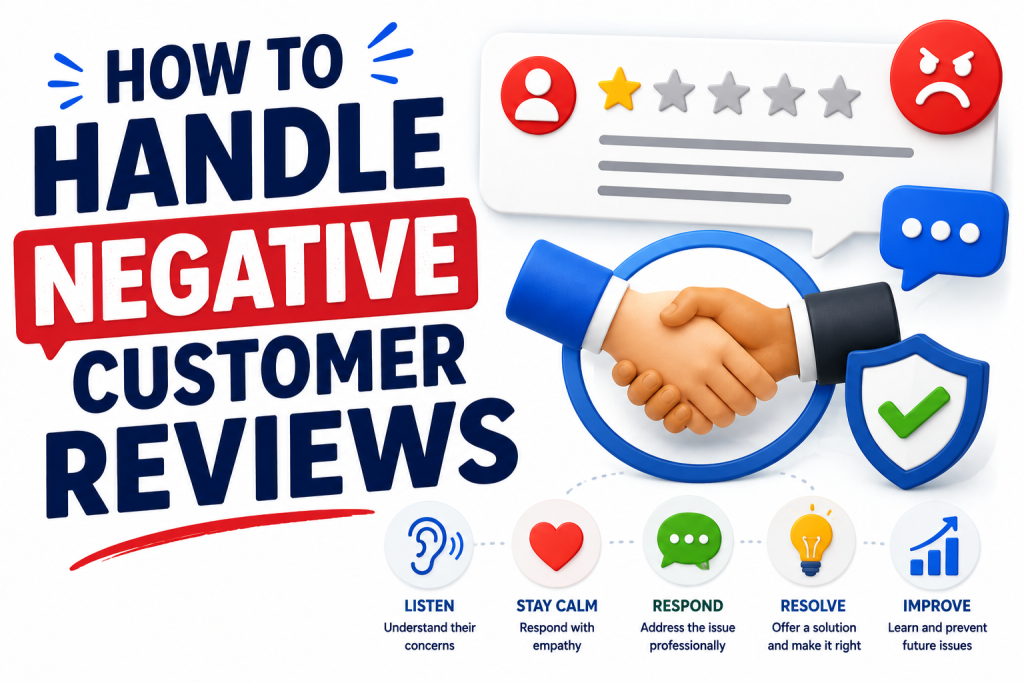
Negative customer reviews are part of doing business online. Even companies with good products and strong customer service can receive criticism from time to time.
A negative review can be uncomfortable, especially when the business believes the situation could have been handled differently. However, ignoring the review or responding emotionally can create a bigger problem.
The better approach is to treat negative feedback as an opportunity to understand the customer, resolve genuine problems, and improve the experience for future customers.
Handling negative reviews professionally can also show potential customers that your business takes responsibility and listens when something goes wrong.
Why Negative Customer Reviews Matter
People often look at customer reviews before deciding whether to buy from a business.
A negative review may make a potential customer hesitate, but the review itself is only part of the picture.
People may also look at:
How the business responded
Whether the problem was acknowledged
Whether a solution was offered
Whether similar complaints appear repeatedly
Whether customers generally have positive experiences
This means a negative review does not automatically define your business.
The way you handle it can influence how future customers perceive your company.
Do Not Panic When You Receive a Bad Review
The first reaction to a negative review may be emotional.
You may feel that the customer is being unfair or that the review does not represent your business.
Take a moment before doing anything.
Do not immediately write a response while you are frustrated.
Instead, read the review carefully and collect the relevant information.
A calm response is usually more effective than a defensive one.
Understand What the Customer Is Saying
Before responding, identify the actual complaint.
Sometimes a customer leaves a low rating because of one specific problem.
The issue could involve:
A delayed order
Poor communication
A product problem
A billing concern
A service mistake
A scheduling issue
Long waiting times
Unclear information
An unresolved support request
Understanding the exact issue helps you decide what action is appropriate.
Check What Happened Internally
If possible, investigate the situation before responding.
Check the customer’s order, service history, communication, or other relevant information.
Speak with employees who were involved.
The goal is not to prove that the customer is wrong.
The goal is to understand what actually happened.
You may discover that the customer misunderstood something.
You may discover that your business made a mistake.
You may find that both sides experienced the situation differently.
Good information leads to a better response.
Acknowledge the Customer’s Experience
You do not need to agree with every statement in a negative review.
However, you can acknowledge that the customer had a disappointing experience.
A simple response such as:
“We are sorry to hear that your experience did not meet your expectations.”
can create a more professional tone.
Acknowledgment shows that the business is not ignoring the complaint.
Apologize When Appropriate
If the business made a genuine mistake, apologize.
A sincere apology does not need to be complicated.
For example:
“We apologize for the delay and understand how frustrating this must have been.”
The purpose is to recognize the customer’s experience and accept responsibility when appropriate.
Avoid making an apology sound sarcastic or conditional.
Do Not Blame the Customer
Even if the customer contributed to the problem, publicly blaming them can make the situation worse.
Avoid phrases that attack the customer’s intelligence, behavior, or intentions.
Do not say:
“You did not read the instructions.”
“You are completely wrong.”
“This was your fault.”
Instead, explain the relevant information calmly.
Potential customers are also reading your response, so professionalism matters.
Keep Public Responses Focused
You do not need to explain every detail of a complicated situation in public.
A short response can acknowledge the issue and invite further discussion.
For example:
“We appreciate you bringing this to our attention. We would like to understand what happened and see how we can help. Please contact our support team so we can review the details with you.”
This keeps the conversation professional.
Protect Customer Privacy
Never publish sensitive customer information in response to a review.
Avoid sharing:
Phone numbers
Email addresses
Payment details
Account information
Order information that could identify the customer
Private conversations
Personal documents
Even if you want to prove that your business is correct, customer privacy should come first.
Move Complicated Issues to a Private Channel
Some problems require more information than can be discussed publicly.
If you need to access an account, review a transaction, or discuss personal details, invite the customer to contact you privately.
You can still leave a public response acknowledging the concern.
This shows other customers that you are willing to address the issue without exposing private information.
What If the Customer Is Wrong?
Sometimes a customer may misunderstand a policy or provide information that does not match your records.
Do not respond aggressively.
Instead, provide a calm clarification.
For example:
“We understand your concern. Our records show a different sequence of events, and we would be happy to review the details with you directly.”
This communicates your position without turning the response into an argument.
What If the Review Appears Fake?
Businesses may occasionally receive reviews that do not appear to represent a genuine customer experience.
Before making accusations, investigate the situation.
Check whether the review violates the platform’s rules.
If you believe it does, use the platform’s official reporting process.
Avoid publicly accusing someone of being a fake reviewer unless you have strong evidence and a clear reason to make such a statement.
A calm response is usually safer and more professional.
Look for Patterns in Negative Reviews
One negative review may represent an isolated problem.
Repeated complaints can reveal something more important.
Suppose several customers mention that your response time is slow.
That could indicate a customer support problem.
If multiple customers complain about delivery delays, investigate your fulfillment process.
If customers repeatedly mention unclear pricing, review the way your services and costs are communicated.
Patterns provide more useful information than individual complaints.
Use Negative Feedback to Improve Your Business
A negative review can reveal an issue that internal teams did not notice.
Use the information to ask better questions.
What caused the problem?
Could it happen again?
Which part of the customer journey needs improvement?
Does the team need additional training?
Should a process be changed?
Would clearer communication prevent similar complaints?
The objective should be to reduce the chances of the same problem happening again.
Train Employees to Handle Complaints
Employees often become the first point of contact when customers are unhappy.
Give your team basic guidance on handling difficult situations.
Employees should know how to:
Listen carefully
Stay calm
Avoid arguments
Explain solutions clearly
Escalate serious problems
Protect customer information
Follow up when necessary
Consistent training can make customer complaint handling more effective.
Do Not Ignore Negative Reviews
Ignoring criticism can create the impression that the business does not care.
Not every review requires a long response, but serious or meaningful complaints should receive attention.
A customer may have spent time writing the review because they wanted to be heard.
Acknowledging that feedback can help demonstrate that the business is paying attention.
Do Not Copy and Paste Every Response
Generic responses can make customers feel ignored.
If every negative review receives the exact same message, the business may appear to be responding automatically rather than listening.
Personalize the response based on the actual complaint.
You do not need to write a long response.
Simply mentioning the specific concern can make the communication more human.
Respond to Positive Reviews Too
Negative reviews should not receive all your attention.
Positive reviews also provide opportunities to strengthen customer relationships.
Thank customers for sharing their experiences.
Mention something specific when appropriate.
This helps create a balanced review management process.
Encourage Honest Feedback From More Customers
Businesses should continue inviting customers to share genuine feedback.
After an appropriate purchase or service interaction, ask customers whether they would like to share their experience.
Do not tell them what rating to leave.
Do not provide a script that controls what they write.
Simply make it easy for them to provide honest feedback.
This can help create a broader and more representative review profile over time.
Do Not Pressure Customers to Change Reviews
If a customer leaves negative feedback, focus on solving the actual problem.
Do not pressure them to remove or change their review.
If the issue is resolved, the customer can decide what they want to do with their feedback.
The goal should be customer satisfaction rather than controlling the public conversation.
Track Negative Feedback
Businesses can learn more when they track complaints over time.
Create categories for common issues.
For example:
Product
Service
Delivery
Communication
Pricing
Support
Scheduling
Billing
Then review the categories regularly.
This can help identify where the largest problems are occurring.
Measure Improvement Over Time
Handling negative reviews is not only about responding to individual customers.
Look at whether the business is improving overall.
Are complaints becoming less frequent?
Are response times improving?
Are similar problems appearing less often?
Are recent reviews more positive?
Are customers mentioning improvements?
These indicators can help determine whether your changes are working.
When Should You Escalate a Complaint?
Some reviews may involve serious matters that require additional attention.
Escalate when a complaint involves issues that your normal customer service process cannot handle.
The exact process depends on your business.
Employees should know who to contact when a complaint becomes more complex.
Having an escalation process prevents serious concerns from being handled casually.
A Simple Process for Handling Negative Reviews
Businesses can use a straightforward process:
Read the review.
Understand the complaint.
Check the facts.
Determine whether the business made a mistake.
Respond calmly.
Apologize when appropriate.
Offer a reasonable next step.
Protect private information.
Record recurring problems.
Improve the underlying process.
This keeps the focus on both reputation and customer experience.
Final Thoughts
Negative customer reviews do not have to become long term reputation problems.
They can be difficult to receive, but they can also provide useful information about what customers experience.
The key is to stay calm, understand the complaint, investigate what happened, and respond professionally.
If the business made a mistake, take responsibility.
If the customer is confused, provide clear information.
If the review appears to violate platform rules, use the appropriate reporting process.
Most importantly, look for patterns and use customer feedback to improve the business.
A company cannot control every review a customer writes. It can control how it treats customers, how it responds to criticism, and what it does to prevent the same problems from happening again.
That is what makes negative feedback valuable in the long term.
Frequently Asked Questions
How should I respond to a negative customer review?
Read the complaint carefully, investigate the situation, acknowledge the customer’s concern, and respond calmly. If appropriate, apologize and offer a way to resolve the issue.
Should I respond to every negative review?
Important and genuine complaints should generally receive attention. The response does not need to be long, but it should be professional and relevant.
What should I do if the customer is wrong?
Avoid publicly attacking the customer. Provide a calm clarification and invite them to contact the business if additional information is needed.
Should I apologize for a negative review?
If the business made a mistake or the customer had a genuinely poor experience, a sincere apology can be appropriate. You can also acknowledge the customer’s frustration without admitting fault when the facts are unclear.
Can negative reviews hurt my business?
Negative reviews can influence customer perception, especially when they describe serious or repeated problems. However, the overall review profile and the way the business responds can also influence how customers evaluate the company.
Can negative reviews help a business?
Yes. They can identify problems, reveal customer expectations, and provide opportunities to improve products, services, and customer support.
Should I delete a negative review?
Do not try to remove legitimate criticism simply because it is negative. If a review violates a platform’s rules, use the platform’s official reporting process.
What if I think a negative review is fake?
Investigate the review and check the platform’s policies. If it appears to violate the rules, report it through the appropriate process. Avoid making unsupported public accusations.
Should I argue with a customer who leaves a bad review?
No. Public arguments can damage customer trust and make the business appear defensive. Keep the response factual and professional.
Should I offer compensation for a negative review?
If compensation is appropriate for resolving a genuine customer problem, handle the matter according to your business policies. Keep private details out of the public review response.
Can I ask a customer to change a negative review after solving the problem?
The focus should be on resolving the customer’s problem rather than pressuring them to change their review. The customer should decide whether they want to update their feedback.
How can I prevent negative reviews?
Focus on reliable products, clear communication, good customer service, realistic expectations, and quick problem resolution. Regular customer feedback can also help identify problems before they become larger issues.
How do I handle repeated negative reviews about the same issue?
Treat repeated complaints as a pattern. Investigate the underlying cause and make changes to the relevant product, service, employee training, or business process.
Should employees be trained to handle negative reviews?
Yes. Employees should understand how to remain professional, protect customer privacy, avoid arguments, and escalate complicated complaints when necessary.
What is the most important rule when handling negative reviews?
Stay professional. Do not respond emotionally, insult customers, reveal private information, or turn the review into a public argument. Focus on understanding the problem and finding a reasonable solution.